Regulatory research and RegTech: the winning combo in Switzerland

Regulatory research and RegTech

Financial regulation is often a complex issue for Swiss banks. The same applies to their lawyers and consulting firms. How can they combine a good level of compliance and risk mitigation, with real efficiency at work, when they’re running out of time? We believe that these professionals have everything to gain from adopting a RegTech regulatory search tool. Find out more in this article about the benefits and functionalities of this type of solution for the world of finance.

1 – Why is regulatory search often a pain point for banks?

The Swiss financial sector is complex. It comprises multiple layers of regulation. Laws, ordinances, FINMA circulars and self-regulation are essential elements of the Swiss regulatory landscape for banks. The texts overlap. They are subject to regular changes. Sometimes, for specific questions, financial services specialists need to study additional documents. These include explanatory reports and consultation reports. It’s often difficult to keep track of all this information.

1.1 – The complexity of multi-source, evolving financial regulation

One of the challenges faced by financial professionals in Switzerland is navigating the vast amount of text relating to financial regulation. Whether they emanate from the Swiss prudential authorities, the Basel Committee or European and international institutions, there are numerous sources to consult. Bank employees have to deal with thousands of pages of financial regulations.

From reporting and banking ratios, to risk management and regulatory changes, these financial professionals need to find the right information. The sheer volume of regulatory data requires an understanding of its structure. It also requires keeping abreast of new developments and changes with the various players involved in compliance.

1.2 – Challenge to quickly find the information you are looking for in the regulations

Without access to an effective research tool, these banking industry professionals find it challenging to find the right information quickly. How can they identify not only the relevant regulations, but also related legal documents (explanatory reports, consultation reports, etc.)?

1.3 – Numerous regulatory texts with a high cost of compliance

The large amount of information that needs to be consulted in order to apply the regulations to banks in Switzerland generates significant financial costs. All this time spent on regulatory research, without adequate tools, represents an expenditure of energy and therefore money. Add to this the risk of non-compliance due to misunderstanding or oversight, and the economic impact is even greater. Reducing these costs is a real challenge for the banking sector.

2 – The need for a RegTech-type regulatory research tool

To quickly find what you need in the regulations, with an up-to-date overview, while reducing risk, adopt a RegTech-type search tool.

2.1 – The need to rationalize document searches with a tool

To avoid having to manually search through many documents, professionals benefit from using an IT solution. It structures their work. This is the case when preparing documentation for special restatements, for example in view of upcoming vacations. It’s also a need within a banking department, or between collaborators in a consultancy firm who want to exchange information efficiently on a regulatory subject.

2.2 – Why use new RegTech technologies?

RegTech or Regulatory Technology refers to a set of IT applications that help banking organizations and the companies that advise them to comply with laws and regulations. These tools use Tech technologies such as automation, artificial intelligence and Big Data, generally in a cloud environment.

By adopting a Fintech tool specialized in regulation, it becomes possible to streamline searches and track relevant information for regular use. The services offered by RegTechs also make it possible to comment online on texts and share information within a team at a bank or law firm.

2.3 – Making regulations a working tool through structured research

RegTech to search in regulation is a powerful tool. The use of specialized applications in research speeds up the process and increases accuracy. In fact, investigations cover not only the regulations themselves, but also related documents such as explanatory or consultation reports.

What’s more, a regulatory search tool reduces work time by allowing specific keywords or phrases to be entered into an engine. Bank employees no longer have to manually scour several documents or websites. With RegTech, searching for information finally becomes fast and convenient. You reduce the complexity of financial regulation.

RegTech solutions work with constantly updated documentation. They are online research tools. This means you always have an up-to-date overview of regulatory information. And let’s not forget that future regulations are also displayed.

2.4 – Reducing risk with RegTech regulatory research

Having access to an efficient search tool when working with Swiss financial regulations has many advantages. Financial professionals dealing with Swiss regulations can locate relevant information faster and more accurately. The result is a streamlined workflow that helps reduce the risk of non-compliance.

3 – Regulatory research: the advantages of e-Reg, a Swiss RegTech platform

easyReg is a RegTech company. It is dedicated to simplifying financial regulation in the Swiss banking sector.

3.1 – The mission of easyReg, a RegTech specialized in regulatory management and research

At easyReg, we’ve created a RegTech platform to help professionals working with financial regulation. Whether it’s to facilitate day-to-day tasks such as applying essential regulatory ratios or making a regulatory change, for example, e-Reg agilizes your research. Our tool digitizes all work, which improves traceability.

By adopting this technology, you :

  • save time on all regulatory tasks;
  • Reduce the financial cost of regulatory oversight and compliance;
  • increase regulatory compliance and minimize risk.

3.2 – Examples of regulatory research using our RegTech solution

e-Reg enables companies in the Swiss banking sector to carry out their research completely digitally. Technology brings flexibility and speed to this type of task.

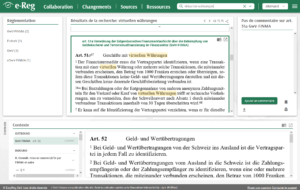
Example 1: regulatory search for “virtual currencies”

On June 30, 2023, the deadline for implementation of the new CHF 1,000 threshold for virtual currencies has approached. Search for “virtuellen währungen” to access art. 51a OBA-FINMA, which describes the requirement (2nd search result).
Example 2: Direct access to specific regulations

Users of the e-Reg service can enter only the number of a FINMA Circular to access it directly. For example, typing “2301” into the search engine will return FINMA Circular 23/01:
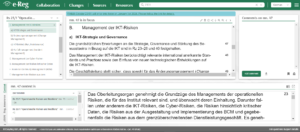
FINMA 2301


If you type “2301 47”, you will immediately obtain the text of Mn 47 of the same FINMA Circular 23/01 :
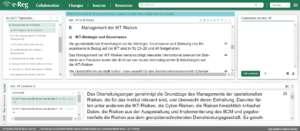
To access art. 22 a of the OBA-FINMA, enter “22a OBA-FINMA” in the regulatory search engine, without forgetting the hyphen:
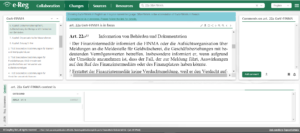
22a OBA-FINMA

Example 3: Basel Committee

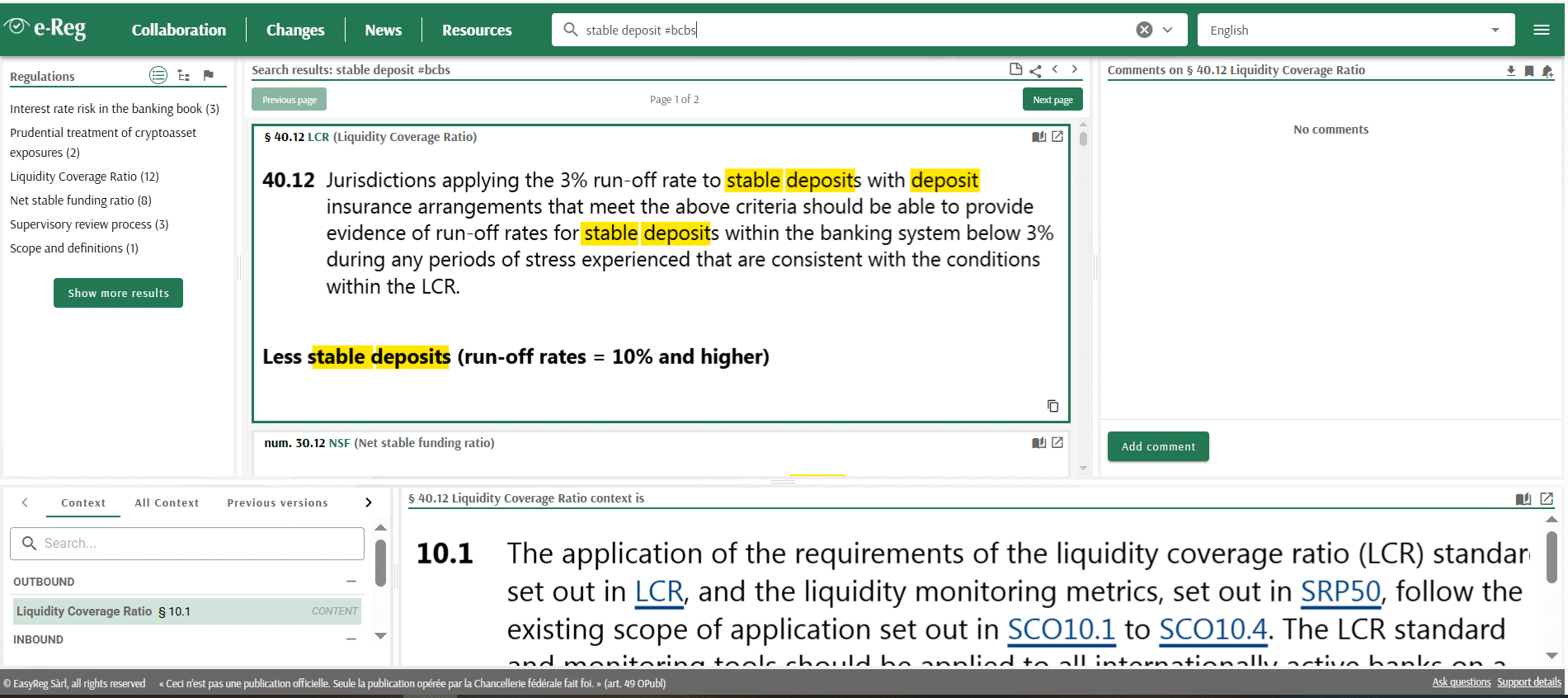
e-Reg also allows you to search across international frameworks, including Basel Committee and European regulations. For instance, searching for “stable deposit #bcbs” will instantly retrieve all relevant mentions of the term within Basel Committee documents and related files tagged with #bcbs.
 

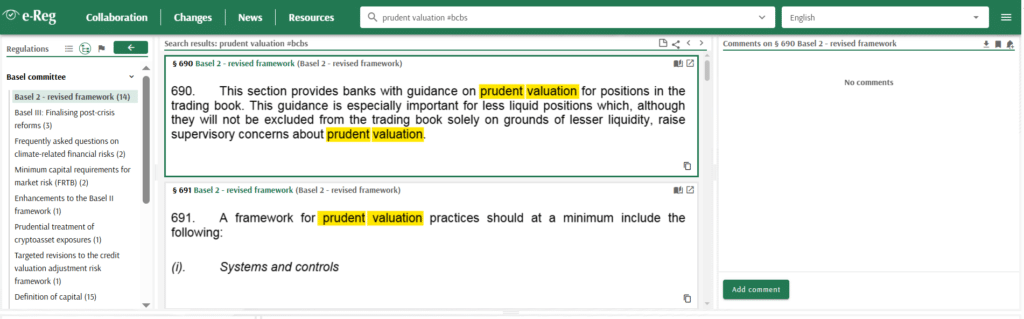
Example 4: Basel Committee

By entering “prudent valuation #bcbs”, our RegTech solution quickly isolates every reference within the Basel Committee framework, ensuring your compliance with the latest Basel Committee standards.
Example 5: European standards

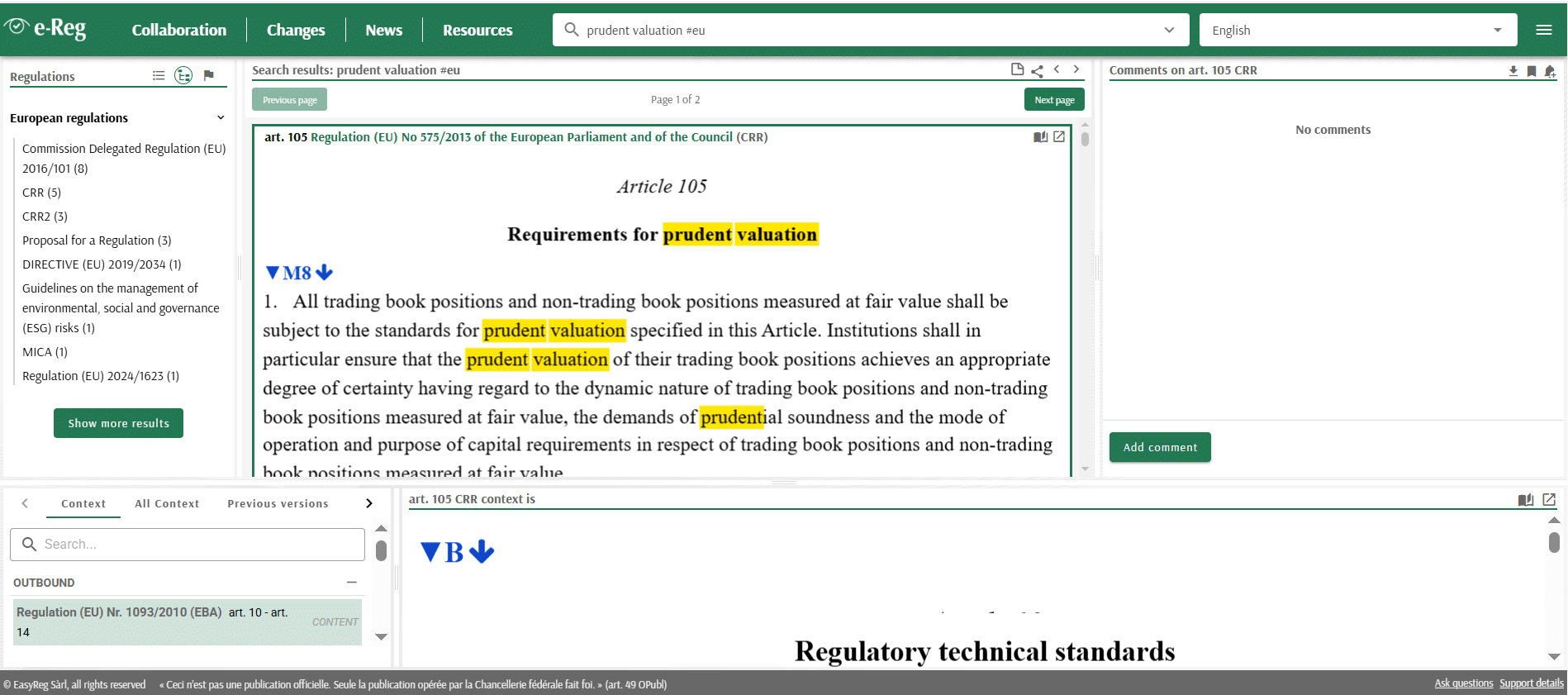
e-Reg also streamlines access to European standards. By searching for “prudent valuation #eu”, it directly identifies key regulatory requirements, such as Article 105 of Regulation (EU) No 575/2013 (CRR).
3.3 – Other services offered by our RegTech solution

e-Reg is not only a search tool, but also :

  • obtaining additional information to the main regulatory search with the presence of context (additional reports and history of financial regulations);
  • add personal comments directly in the tool;
  • share information or comments within a department (send a notification to the employee);
  • collaborative project management, e.g. for a regulatory change, with task allocation and status management;
  • knowledge management with traceability of data and information, with comments where appropriate;
  • the provision of a multilingual library of applicable regulations, with all relevant links included in the database.

Regulatory research with RegTech makes compliance management much easier. The technology used speeds up the work, makes it more precise, and helps to pass on knowledge as knowledge. By opting for such a tool, a bank or banking consultancy gains in efficiency and reduces the cost of regulation. To convince you, we offer an online demonstration of our e-Reg platform. Make an appointment now!


👉 Sign up for our Newsletter to keep up to date with the latest regulatory news and follow any announcements of new rules or major changes.

Financial regulation: discover who the potential customers of our RegTech solution are

Financial regulation RegTech

e-Reg is a Swiss RegTech. It dematerialises and simplifies working with financial regulations. It also facilitates collaborative working in project mode. We take a closer look at the various type of e-Reg customers. Discover the features and benefits of our tool for each of them, whether they are professionals in the financial services sector, consultants or lawyers.

1 – e-Reg, a Swiss RegTech solution that focuses on managing financial regulation

Financial regulation remains an area that often lacks simplicity for its various players, whether they work directly in financial services or in a consultancy firm. Acts, ordinances and circulars issued by FINMA follow one another and add to one another as each global financial crisis unfolds. Rapid advances in technology (e.g. blockchain, AI) and new risks (nature, etc.) are also giving rise to new regulations.

1.1 – Financial regulation can be simplified

We firmly believe that the regulatory complexity experienced in Switzerland can be mitigated. We know, from our own experience in the Swiss banking industry, that there is a need for a tool to make regulatory work easier. Hence, we developed e-Reg, a cutting-edge RegTech platform, to alleviate the burdens associated with regulatory compliance for all stakeholders involved.

1.2 – The essential functionalities of e-Reg for financial regulation

e-Reg users have access to two types of RegTech services for their financial regulation activities.

1.2.1 – Document management

e-Reg is first and foremost a search tool for acts, FINMA ordinances and circulars, texts relating to self-regulation, and so on. Our RegTech solution provides the full context of a search as well as regulatory developments, such as the Basel III final. The results include clickable links for easy navigation from one regulation to another.

e-Reg also allows users to consult procedures and directives internal to the financial institution, which enriches the analysis. Users can also add comments and have access to online libraries.

1.2.2 – Collaborative management in project mode

e-Reg can also be used to manage cross-functional projects such as :

  • Transferring knowledge between teams, particularly in the event of absences during holidays and when new recruits are hired with little training in regulations.
  • Implementing a regulatory change and collecting internal analyses in the event of consultation with the authorities or during an impact study on a new regulation.


2 – e-Reg, a solution for the financial services sector within Swiss banks

The first category of customers targeted by e-Reg are employees in the Swiss banking sector who are faced with the issue of compliance and regulatory requirements.

2.1 – e-Reg, a natural solution for departments managing regulatory monitoring

The ‘regulatory monitoring’ departments, which are responsible for ensuring that all Swiss or foreign regulatory changes are captured and managed, are natural users of the e-Reg solution.

These employees use the various monitoring features to keep up with the latest news and the change tracking features to ensure that every change has a responsible party and is managed by the institution.

2.2 – The benefits of e-Reg for the bank’s finance department

The finance function frequently faces decisions that significantly influence regulatory ratios and compliance across diverse regulations. Navigating these realms entails referencing myriad texts, often layered with overlapping regulations. Moreover, professionals in the banking sector must contend with the additional complexity of adhering to foreign regulatory frameworks.

It’s essential to have the right information at your fingertips to avoid mistakes and negative comments from the regulator. A finance department has everything to gain by using e-Reg to structure its research and analysis. What’s more, it’s also a way of improving regulatory knowledge and training thanks to our platform.

💡 Find out how RegTech makes it easier to document special treatments.

2.3 – e-Reg’s collaborative function, a real plus for in-house lawyers

They sometimes carry out regulatory monitoring, a task for which they rarely have powerful tools. This is precisely one of the strengths of our RegTech solution. In fact, e-Reg systematically provides all the context surrounding a regulatory search, including draft changes to legislation. Everything is directly integrated in the same place, making analysis easier. The person in charge of the watch can easily add comments. They can notify a colleague. All their work remains tracked and accessible from the dashboard.

2.4 – Risk managers: potential users of RegTech

These professionals make extensive use of regulation in their risk monitoring activities. They take a close interest in regulatory changes, even if they do not personally manage such projects. They appreciate the functionalities of our e-Reg platform for its regulatory work and research. This ensures that the bank reduces its risk of non-compliance.

3 – e-Reg, a platform for professionals advising banks on financial regulation

Banks and financial institutions call on external specialists to manage regulatory compliance. e-Reg is also aimed at all these potential players in financial regulation in Switzerland.

3.1 – Financial regulation consultancies

There are many companies involved in financial regulation in Switzerland. The largest are generalists. Others, smaller and more specialised, offer specific expertise. In both cases, RegTech is a real asset for these professionals to increase efficiency and deliver more value to their clients.

3.1.1 – Partners and employees of small firms involved in financial regulation

In these small, multi-skilled structures, using RegTech for regulatory management and research provides immediate work comfort for employees. In their compliance missions, they have to carry out numerous searches in thousands of pages of regulations.

The tool provides them with :

  • fast and efficient search ;
  • exhaustive coverage of current regulatory sources and planned developments, with full context;
  • features for sharing information within the firm, which is also a good way of improving staff training.


3.1.2 – Junior consultants in large audit firms

Even large companies have every interest in using our RegTech solution, particularly for their junior consultants. It provides them with a totally digitised way of finding their way through the various layers of regulation and of learning.

e-Reg’s functionalities help managers to share their analyses of regulatory developments and the regulations in force with younger colleagues. They can also assign tasks directly in the tool and notify them. They can monitor progress on the dashboard.

In addition, e-Reg offers the option of adding the firm’s own policies and directives to the platform, in a private and segregated environment. This enriches the regulatory analysis and helps junior members to apply internal rules and guidelines.

3.2 – Law firms working with Swiss banks

The last typical client group for e-Reg is lawyers. As in the case of consultancy firms, large specialist firms work alongside smaller structures. The latter are multidisciplinary and work on a case-by-case basis on regulatory issues.

4 – IT solution providers for banks

The e-Reg solution is also used by a specialist banking software publisher to ensure that their solution takes into account the latest regulatory developments and thus anticipates customer needs.

5 – Conclusion

Even though all professionals in the financial industry are used to using websites specialising in financial regulations, the demonstration of our tool shows that technology saves them time. They work faster. They can keep perfect track of their analyses as the texts are commented on.

RegTech provides simple, operational solutions for most players in financial regulation. With e-Reg, our customers gain in efficiency. They reduce the cost of compliance. They also make it easier to pass on knowledge within their teams, which is essential for junior staff as well as for collaborative projects. To improve your understanding of the tool, sign up for an online demonstration of e-Reg.

👉 Sign up for our Newsletter to keep up to date with the latest regulatory news and follow any announcements of new rules or major changes.
Why and how should internal regulations, directives and policies be integrated into your RegTech tool ?

réglementation financière interne : politiques et directives propres dans un environnement privé RegTech

RegTech solutions simplify the task of regulation in the financial services sector. They streamline both regulatory research and the organisation of regulatory activities. But the right solutions, like e-Reg in Switzerland, go further. Find out how they combine internal regulations (directives, policies, etc.) with external sources, with numerous benefits for their users.

1 – RegTech tools: solutions for managing financial regulation

Whether you work for a bank or a consultancy firm handling regulatory matters in Switzerland, you will be familiar with the complexity of the financial regulation.

1.1 – Large quantities of information to be researched and managed

The management of financial regulation involves thousands of pages of various sources to be consulted, interpreted and sometimes compared. These include the explanatory reports issued by the FDF and FINMA. Then there is the self-regulation that comes from the directives, recommendations and positions of the SBA and the AMAS.

In addition, certain regulatory changes are justified by other legal sources. This is the case, for example, with the New Data Protection Act (nLPD). Finally, the financial services sector knows the importance of consulting draft legislation such as that relating to final Basel III.

1.2 – The need to simplify financial regulations

Managing financial regulations is often a real concern. It is a time-consuming and costly process, not to mention the risk of non-compliance. For these financial services players, it means looking for ways to simplify the process. Solutions exist thanks to Regulatory Technology or RegTech.

1.3 – The principles of RegTech

The definition of RegTech can be summed up as follows: a range of technological services for the banking sector to comply or remain compliant with both regulations and laws.

Whether they are working alone or as part of a team on a regulatory project, financial services specialists have their work facilitated using RegTech solutions. For example, they can document all their special treatments dematerialised or train a back-up for holidays.

1.4 – Why and how should the financial services sector go further than external regulation?

RegTech brings transparency and consistency. It helps to standardise regulatory processes. However, these professionals who deal with regulation have broader needs than just sources of information external to the banking institution.

a – Need to access the institution’s internal policies in addition to legal financial regulations

Each banking institution must issue its own provisions that must be complied with. These may take the form of internal regulations, procedures, directives, codes of conduct or policies drawn up by the bank itself. For the specialists concerned, it makes sense to be able to consult all the financial regulations, both internal and external, in one place. This allows them to see directly how the bank deals with an external regulatory requirement.

b – Use of RegTech solutions that combine the two types of regulation, internal and external

Some RegTech solutions such as e-Reg make internal and external document management possible in a single instance solution. This means that compliance teams have all the latest information in one place. They benefit from similar functionalities for both internal and external financial regulations:

  • search engine ;
  • collaborative solution ;
  • management of links between the two types of data (in the context of the regulations consulted) ;
  • etc.

2 – e-Reg, a platform for combining internal and external financial regulation

At easyReg, we are well aware of the needs of financial services, so we have designed our collaborative online platform e-Reg to keep both the external and internal regulatory environment under control.

2.1 – Functions of our RegTech for regulatory specialists in Swiss banks

With our RegTech system, banks and the companies that advise them on regulatory matters can :

  • Carry out a regulatory search in all texts as well as working notes and user comments, in several languages.
  • Obtain additional information essential for analysis and understanding, the regulatory context.
  • Write comments and inform the team.
  • Manage a project collaboratively by assigning tasks to named individuals.
  • Manage knowledge and regulatory libraries.

2.2 – The advantages of internal financial regulation stored in a private and segregated environment

e-Reg is a RegTech solution that offers the option of adding your own internal policies and procedures to the tool. In this way, each financial institution can improve compliance monitoring and enforcement. By adopting this platform, users increase their regulatory oversight. Only users who choose a fully segregated environment can benefit from this functionality.

Obviously, this bank-specific financial data remains accessible only to that bank. The RegTech solution separates this information for internal use into separate, secure compartments.

a – Have an overview of all relevant points for better control and risk limitation

Banks that add their own internal financial regulations to e-Reg benefit from enriched results. By performing a regulatory search, using a keyword or a reference (ordinances or FINMA Circulars, for example), they improve the context of their search. Each clickable link at the bottom of the screen can be used to link external and internal regulatory information.

b – Use the power of search functions for internal financial regulation too

It is therefore a system that maximises the use of banks’ internal policies and procedures. With e-Reg, users benefit from the power of the platform’s search engine, and not just for external regulations. This reduces the risk of forgetting an internal bank directive or requirements that already exist as part of a regulatory activity. It also means that questions from internal and external auditors can be answered more quickly.

c – Centralise all information into one place to save maximum time

This means that financial services staff can access all the information they need at the click of a button. They save time. They can be sure of having an comprehensive and concise view of the texts of acts, regulations and circulars, as well as internal procedures, without having to consult multiple systems.

d – Automatically manage versions, historical records and any translations of internal regulations

Our RegTech solution can keep track of the different versions of internal regulatory information. It automatically manages any translations into English, French, German or Italian of the internal regulatory policies of banks in Switzerland.

e – Working with e-Reg, a plus also for monitoring the bank’s internal regulatory framework

Finally, those in charge of a regulatory change project based on internal bank provisions benefit from the collaborative aspect of e-Reg. Thanks to the dashboard integrated into the application, they can visualise the progress of the tasks to be carried out. There’s no need to use other project management systems.

2.3 – Example of the use of e-Reg to manage the internal regulatory framework of financial institutions

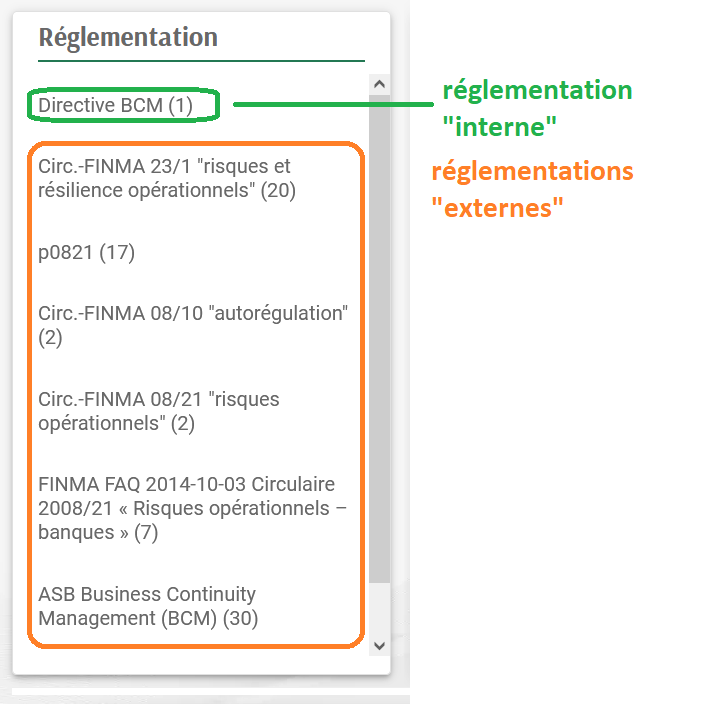
You search in e-reg for “BCM”, the name of an internal directive at your bank. Here is how the result is displayed in e-Reg :

recherche dans la réglementation financière interne


You can see how the solution monitors a bank’s internal financial regulations. Key external regulations also appear in the result. These include the new FINMA Circular 23/01, which will replace FINMA Circular 08/21. The self-regulation on the subject, “ASB Business Continuity Management”, is also included.

Banks’ internal financial regulations are best controlled using a RegTech solution. By inserting your own procedures and policies into our regulatory management application, you can fully leverage all the benefits of e-Reg. We can show you how to implement this process in a personalised demo.


👉 Sign up for our Newsletter to keep up to date with the latest regulatory news and follow any announcements of new rules or major changes.
Customise your regulations using RegTech tools such as e-Reg

Customize regulations using RegTech tools

RegTech companies offer the banking sector a wide range of regulatory and compliance management services. Some of these RegTechs, such as easyReg, specialise in tasks requiring the exploitation and analysis of regulations. Nowadays, RegTech tools of this type are able to go further than just processing standard texts. Discover the various layers of solution offered by such RegTechs , from its foundation to all possible customisations.

1 – RegTech tools: standard features for managing regulation in banks

Let’s focus first on the foundation offered by RegTech tools for managing regulatory data and information.

1.1 – What does a Regulatory Technology application do for regulatory management?

The new technologies exploited by RegTech companies combined with regulatory research constitute a real winning combo for their users. Indeed, one of the major difficulties faced banks and consultancies is the wealth and complexity of regulations.

So a Regtech solution like e-Reg offers a wide range of functions, from regulatory knowledge to collaborative information management and regulatory project management. Here is the main scope of such a tool :

  • search for regulatory texts that need to be applied in Switzerland ;
  • broaden the analysis by accessing the entire regulatory context surrounding the query made in the tool ;
  • have access to draft changes to the texts ;
  • manage and structure knowledge within a bank or law firm (comments, information sharing, regulatory libraries).

1.2 – Benefits of new RegTech-type technologies for managing banking compliance

This type of RegTech tool provides comfort and peace of mind for people whose work revolves around regulations. Let’s summarise the benefits for regular users :

  • improved compliance and reduced risks of non-compliance and the associated costs ;
  • time savings for financial services staff ;
  • development of regulatory knowledge and skills, particularly for new recruits ;
  • digitisation of tasks and traceability of regulatory analyses and research.

1.3 – What are the standard regulations generally covered by RegTech solutions like e-Reg?

Our e-Reg online platform includes a base of regulations common to all users. In a way, it is the documentary standard accessible to everyone.

Here are the databases that we integrate into the RegTech tool, representing thousands of pages of financial regulations :

  • acts, ordinances and FINMA orders applicable to financial services in Switzerland ;
  • explanatory reports, comments and consultation reports issued by FINMA and the FDF ;
  • self-regulation, i.e. positions, recommendations and guidelines published by the AMAS and the SBA ;
  • other data relating to regulatory changes, i.e. outside the laws mentioned in Art. 1 of FINMASA ;
  • certain European Union regulations affecting banks in Switzerland ;
  • international texts, such as those relating to Basel III final.

1.4 – RegTech tools and the regulatory context: example of a query on the e-Reg platform

As standard, our Regulatory Technology solution provides access not only to the results of regulatory research, but also to the entire context. This includes additional information such as additional reports and the history of financial regulations. It helps to enrich reflection and documentary analysis.

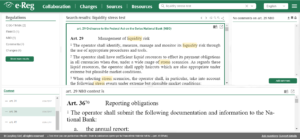
Would you like to understand what we make available to e-Reg users in banks or law firms? Here is an example of a regulatory search on the e-Reg platform for the expression “liquidity stress test”.

The window at the bottom of the screen gives access to the context, in this case the extract from the explanatory report of 4 November 2020, which deals with the subject of proportionality for stress tests in small banks.

liquidity stress test

2 – Some RegTech solutions go further in terms of regulation

In addition to this standard block offered by traditional RegTech tools, with e-Reg we provide other functionalities. We enable our customers to add additional regulations directly on the platform.

2.1 – Regulatory research: the needs of the financial services sector

Our customers express the need to centralise official Swiss regulations as well as their internal procedures or directives in one centralized place. Sometimes, for uses that are specific to their bank or their particular business, users would like to be able to consult, comment and share extracts from regulations outside of Switzerland. These may be European or international laws or regulations, for example.

2.2 – On-demand modularity of our RegTech tool

Given the needs of the financial services sector for efficient organisation and optimum compliance, we offer modularity in addition to the standard process. This ensures that users of our RegTech application have access to all sources of information centralised in a single, shared space within their institution.

2.2.1 – Possible integration of external regulations into e-Reg

The ability to add to the e-Reg regulatory information database directly within the tool widens the scope of what can be done. For example, if a customer wishes to add external regulations to meet the needs of an external establishment, this can be envisaged. In fact, the database can be expanded on demand.

2.2.2 – Possible option for a banking institution’s internal regulation module

One of the innovations we have introduced into the RegTech application is the ability to insert a financial institution’s own directives and procedures. This addition is  made in a totally secure and segregated environment. As a result, employees working in the regulatory field have access to all sources of documentation, both internal and external, for each search. This simplifies collaborative project management within teams.

To find out more, read our article on this subject. It will give you a better understanding of how and why your bank’s internal regulations should be integrated into our RegTech tool.

2.2.3 – Possibility of adding to the standard if this is a plus for all users

Finally, please note that we may decide to enhance the standard base of regulations in e-Reg. This is particularly the case if a specific need expressed by a bank or consultancy is of interest to all users. That’s why our RegTech platform is scalable. What’s more, innovation is in our genes. We are constantly thinking up and deploying new functionalities, thanks to technology, in particular Artificial Intelligence (AI). One example is semantic search or vector search, a real enhancement for exploiting regulatory data.

This type of personalisation service offered to our customers in the RegTech application improves the work of our employees. With more regulations available, users are better able to comply with regulatory requirements. It’s one way of reducing the risk of non-compliance in the companies that are responsible for them. Nothing beats a personalised demonstration of the e-Reg tool. Choose a slot directly on Enrico Giacoletto’s calendy.


👉 Sign up for our Newsletter to keep up to date with the latest regulatory news and follow any announcements of new rules or major changes.
The complexity of financial regulation is no longer an inevitability in Switzerland

Financial regulation complexity

Acts, regulations, circulars and standards are piling up and piling up, whether it is in Switzerland, the European Union or at the level of other international bodies. The result is undoubtedly that financial regulation is genuinely complex. However, simplifying what is complex demonstrates a thorough understanding of the subject. Faced with this situation, as experienced by Swiss banks and the consultancies that support them, how can we turn this philosophy into a reality in the regulatory field? Regulatory Technologies, known as RegTech, now provide practical solutions. Find out how in this article.

1 – Regulatory provisions that accumulate and complicate compliance

Financial regulations in Switzerland involve thousands of pages of documentation. Furthermore, the complexity is increased by the fact that regulatory provisions are constantly evolving in order to adapt and respond to the various global financial crises. Yet, Switzerland seeks to reduce this complexity for small banks. It has introduced the concept of proportionality into banking regulation.

1.1 – Multiple sources of regulatory information

Whether the regulatory provisions are Swiss, international or drawn up at European level, for example, all banks are faced with the complexity associated with the sheer volume of information.

Depending on the subjects and reports to be processed financial regulatory management requires consultation of, among other things

  • FINMA acts, ordinances and circulars ;
  • explanatory reports, comments and consultation reports issued by the FDF and FINMA, i.e. 620 pages for 2022 alone ;
  • regulatory sources related to changes in self-regulation (comments and texts of the SBA and AMAS) ;
  • draft legislation, such as the one relating to Basel III final ;
  • regulatory changes induced by legislation other than financial regulations.


1.2 – The complexity of financial regulations is also due to ongoing changes

The balance often remains precarious between too much financial regulations and a lack of regulation in certain areas. For each global banking crisis, there is a corresponding change in legislation. For example, it was in the wake of the 2008-2009 crisis that the Basel Committee began work on Basel III and then Basel III Final.

The new global upheavals, both in the United States and in Switzerland, will probably lead to further changes. Particularly in terms of regulatory ratios, the liquidity risk and interest rate risk aspects are likely to evolve. All these developments contribute to increasing the complexity of financial regulation in Switzerland.

1.3 – Swiss regulators seek to reduce complexity for small banks

Faced with this difficulty in implementing regulatory requirements, Switzerland has introduced simplification measures for the smallest financial institutions. Since the beginning of 2020, small banks have been exempted from certain prudential requirements.

However, FINMA emphasizes the importance of a dynamic approach in its article “Experiences with the small banks regime” published in the small banks dossier. In the same extract from the 2021 Annual Report, it adds that “other possible relaxations will therefore have to be considered in the future when drawing up or updating the regulations”.

2 – A tool to cope with the complexity of financial regulation: RegTech

As written by BSI Economics in 2017. “The complexity of regulation and supervision of the financial system has indeed required several layers of regulation, with the aim of financial stability, aimed at encouraging international cooperation and convergence of standards, both at European and international level.” This is a fact. However, thanks to RegTechs, this complexity is not inevitable.

2.1 – What is a RegTech and what areas does it cover?

RegTechs offer specialised services to financial institutions to manage compliance. RegTech players use technologies such as artificial intelligence, big data, the cloud and automation.

The areas of intervention are numerous. From data protection and anti-money laundering to regulatory monitoring and compliance management, RegTechs cover the full range of regulatory complexity.

2.2 – e-Reg: a RegTech solution to simplify regulatory management in Swiss banks

By adopting a RegTech tool such as the one offered by easyReg, a bank or a consultancy working with financial institutions is able to grasp the complexity.

2.2.1 – Our RegTech mission

Our company’s mission is to simplify all regulatory work. Whether you work in the finance department of a bank, a law firm or a consultancy firm, with the e-Reg SaaS platform, you can benefit from the following advantages :

  • quickly identify the right information in all Swiss and international regulations ;
  • save time in your regulatory management activities ;
  • reduce the cost of compliance as well as the risks of non-compliance ;
  • use a RegTech tool to manage regulatory changes in a collaborative spirit.

2.2.2 – Example: easier document management for special regulatory processes

The holidays are approaching. Are employees within your bank or consultancy firm worried about their backups, who are responsible for replacing them while they are away? You may want to reduce the complexity of financial regulation work scattered across teams. With the e-Reg tool, your teams can organise delicate or arduous tasks in advance.

This is the case for the documentation of special processes relating to regulatory reporting in Switzerland. The same applies to episodic tasks that require detailed study of the regulations. Our platform helps your teams save time by providing clear, up-to-date and easily accessible documentation.

Don’t miss out on RegTech tool available progress. It is possible to implement an adapted technological process designed for the specificities of Switzerland. It relieves the banking sector and all its financial services staff responsible for regulation. Reducing time and costs, limiting risks, streamlining exchanges and managing regulatory changes, RegTech helps to make compliance less complex. If you want to see by yourself, there’s nothing better than an online demo of e-Reg !


👉 Sign up for our Newsletter to keep up to date with the latest regulatory news and follow any announcements of new rules or major changes.

Basel III and Basel III Final: where does Switzerland stand?

bale III et bale III final point étape 2023

In the month of July 2022, the Federal Council and the Swiss Financial Market Supervisory Authority (FINMA) launched a consultation for the purpose of applying the latest Basel III measures in Switzerland. Do you know how the project progresses? Why is it now called Basel III Final in Switzerland (or “end game” in the US) rather than Basel III? What are “Basel IV” and “Basel consolidated”? What’s new for 2024? As Reg Tech specialists, we answer all your questions in this article and provide you with the essential documentary sources you need to know.

1 – Basel III final: what banks need to know

The Basel Committee on Banking Supervision (BCBS) aims to strengthen the global soundness of financial systems. It also aims to ensure efficient prudential supervision and good quality exchanges between banking regulators. It is managed by the central bank governors and banking supervisors of 28 countries, including Switzerland.

1.1 – Basel III and Basel III Final: strengthening banking supervision

The Basel Committee’s work resulted in the issue of rules known as standards, i.e. the minimum that banks and supervisors must apply. The reform known as Basel III is the latest standard in force. Since 2010, it has supplemented Basel II, following the global financial crisis of 2008. The member countries of the Basel Committee are committed to incorporating these measures into their national legislative frameworks.

Basel III strengthens the level of regulatory capital by raising the minimum solvency ratio to 10.5%, compared with 8% in Basel II. The reform also provides for a leverage ratio, which is the ratio between the total assets held by the bank and its equity capital. Finally, it defines the short-term liquidity ratio (LCR) and the long-term liquidity ratio (NSFR).

1.2 – Implementation of Basel III final in Switzerland

The introduction of Basel III final into law includes a revision of the Ordinance on Capital Requirements (OFR). It also includes a complete overhaul of the texts detailing the implementation of the OFR. Circulars 2013/01, 2015/03, 2008/21 (equity capital section), 2017/07, 2016/01 and 2008/20 are repealed. New ordinances of the Swiss Financial Market Supervisory Authority replace them (see below).

1.3 – When will Basel III come into force in Switzerland?

The consultation launched in July 2022 by the Federal Council and the Swiss Financial Market Supervisory Authority was completed in 2023. The amendment to the Capital Adequacy Ordinance, adopted by the Federal Council on 29 November 2023, will come into force on 1 January 2025.

FINMA’s press release of 27 March 2024 also announces the publication of the ordinances to implement Basel III final in Switzerland. These will come into force on 1 January 2025, at the same time as the corresponding changes to the Capital Adequacy Ordinance.

We list all these regulatory changes in a later part of the article, updated in April 2024.

2 – Why talk about Basel III final?

The Basel Committee on Banking Supervision refers to the Basel III reform. However, the second part of the package is actually called Basel III Final.

2.1 – The Basel Committee adopts an initial set of measures

In the wake of the 2008 financial crisis, the shortcomings of the Basel II standard came to light. In 2010, the Basel Committee quickly approved a new regulatory framework for banks and financial institutions. The first version, published in December 2010, was updated in June 2011. However, this is only the first part of the reform requirements. For Switzerland, these initial measures are detailed in the communication from the Federal Department of Finance (FDF) dated 1 June 2012.

2.2 – The other Basel III reforms will be incorporated into Basel III final

On 7 December 2017, the BCBS finally published the final applicable Basel standards. As a result, this section on strengthening banks’ capital according to risk is called Basel III final, as opposed to the first wave of reforms, which dates back several years.

The provisions of Basel III final include risk weightings with various ratios based on company ratings. The standards also incorporate a new approach to operational risk. In Switzerland, Basel III Final will lead to the July 2022 consultation launched by the FDF and FINMA.

2.3 – Basel IV or Basel III final: the Basel Committee has chosen

During the work to implement the Basel III measures, several years after the first series of reforms, two terms emerged: Basel IV and final Basel III. In the end, the BCBS chose Basel III final, as indicated in its 2017 publication.

3 – Regulatory texts and other information on the Basel III final reform in Switzerland

Here is some other useful information and in particular the new ordinances.

3.1 – Where can I find the key texts?

Are you looking for the key articles on this banking supervision reform? Take a look at the following sources:

3.2 – List of new ordinances

You will find all the documentation (draft ordinances, explanatory reports, information on the hearing, etc.) on the FINMA website. Go to the archive of hearings completed in 2022.

The following FINMA ordinances were published at the beginning of 2024:

  • TBEO-FINMA (the Ordinance on Trading book and Banking book and Eligible capital of banks and securities firms) relates to the trading book and the bank’s book, as well as the capital taken into account of banks and securities houses. It replaces FINMA Circular 2013/1 ‘Recognised own funds – banks’.
  • LROO-FINMA (the Leverage Ratio and Operational Risks of Banks and Securities Firms Ordinance) relates to the leverage ratio and operational risks of banks and securities firms. It replaces FINMA Circular 2015/3 ‘Leverage ratio-banks’ and the parts of FINMA Circular 2008/21 ‘Operational risks-banks’ that are still in force.
  • CreO-FINMA (the Ordinance on the Credit Risks of Banks and securities firms) deals with the credit risks of banks and securities firms, replacing the former FINMA circular 2017/7 ‘Credit risks-banks’.
  • MarO-FINMA (the Ordinance on the Market Risks of Banks and securities firms) deals with the market risks of banks and securities firms. It replaces FINMA Circular 2008/20 ‘Market Risks – Banks’.
  • Finally, DisO-FINMA (the Ordinance on the Disclosure Obligations of banks and securities firms) concerns the disclosure obligations of banks and securities firms. It replaces FINMA Circular 2016/1 ‘Publication – Banks’.

3.3 – What is the Basel consolidated format?

In April 2019, the Basel Committee on Banking Supervision (BCBS) brought together the various global standards for banking regulation and supervision. The aim of Basel Consolidated is to bring together all the regulatory provisions and to clarify and simplify the existing standards, without adding any new ones. The approach is explained in this document concerning Basel Consolidated.

4 – How can e-Reg help you with Basel III?

In the face of these ongoing regulatory changes, it is vital to keep up to date on a regular basis. As a financial services professional, you are looking for the right information, accurate and reliable, at all times. That’s where e-Reg can make your job a lot easier.

4.1 – e-Reg a RegTech solution for your search for regulatory documentation

Our aim at easyReg is to simplify your regulatory work. We offer you a service in SaaS mode (Service as a Software) so that, thanks to our search engine, you can access the exact information you need. Whether you are a Swiss financial institution, a law firm or a consultancy, this tool is specifically designed for you.

Instead of searching through Swiss regulations and Basel Committee documents, use e-Reg to obtain not only the precise text, but also its context. It’s a real lever for your analyses and the management of your documentary needs. We also provide you with all the other regulatory information relevant to your subject. You can also consult the comments of your colleagues on these same texts.

4.2 – Search examples for Swiss capital adequacy regulations

There’s no better way to understand our Reg Tech solution than to look at a few concrete cases.

Example 1: regulatory discount

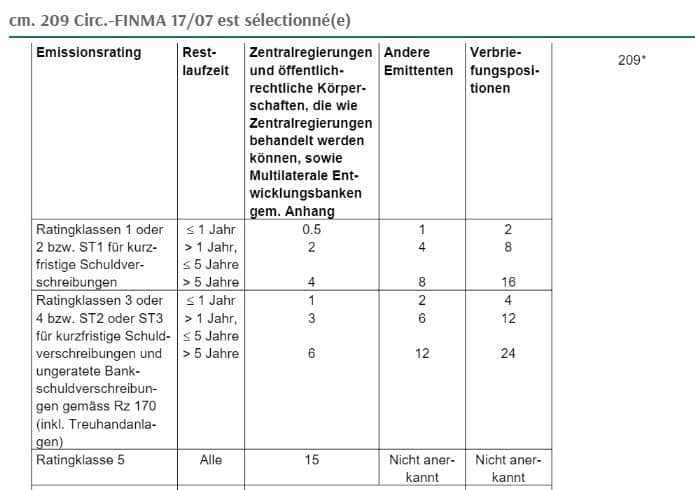
Enter the expression ‘regulatory haircut’ (Sicherheitsabschläge) in our e-Reg search engine:


You will be taken directly to the table of current and future regulations:

Example 2: treatment of second homes in the calculation of equity capital

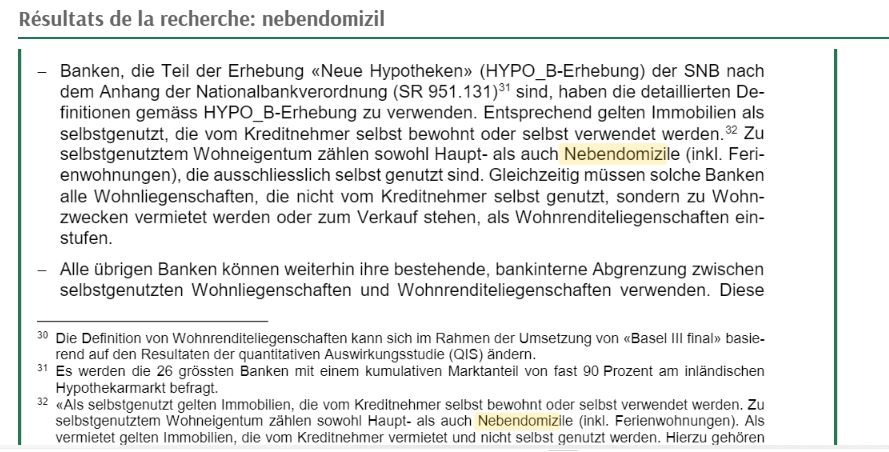
Do you have any doubts about how to calculate equity capital for second homes? Proceed in the same way by entering ‘second homes’ in the e-Reg engine.

You’ll get the following information:

Example 3: Basel III regulations

Our e-Reg platform includes a ‘changes’ module. Here you will find, for example, the item ‘Basel III final’ with access to :

  • an analysis of the main impacts of these new regulations applicable in 2025 ;
  • clickable references to key sources of regulatory information ;
  • the ability to drag reference files into the tool, along with notes and comments.

This example of evolving regulations shows how important it is to have up-to-date, reliable information at all times. At easyReg, this is our business. To find out more about how our platform can help you with your document searches, arrange an online demo of our e-Reg tool.


👉 Sign up for our Newsletter to keep up to date with the latest regulatory news and follow any announcements of new rules or major changes.
e-Reg, a LegalTech platform perhaps, but not only

LegalTech

RegTech or LegalTech, do you know the difference between these technological solutions? e-Reg is a RegTech platform, although it can also be considered a LegalTech. In this article, we explain the missions of these two types of company and the profile of their users. We also explain the features of e-Reg that enable it to be classified in both categories, but above all as RegTech.

1 – What is a LegalTech company?

The concept of LegalTech emerged in the United States and the United Kingdom in the 2000s. It occurs alongside numerous technological developments in the digital field, data processing and artificial intelligence.

1.1 – Definition and history of LegalTech technology

The concept of LegalTech is still relatively new in the world, which is not surprising given the youth of the technologies used.

1.1.1 – What does LegalTech mean?

The term LegalTech is a contraction of legal technology. Wikipedia provides a definition based on the ethical charter for an online legal market and its contributors, an organisation that brings together a large number of legal professionals.

Furthermore, a LegalTech uses technology “to develop, offer or provide products or services relating to law and justice, or to provide access to such products or services for users of the law, whether professionals or not”.

1.1.2 – Technologies for legal efficiency and cost reduction

They are sometimes referred to as “legal start-ups”, LegalTech companies have been in existence mainly since the last decade. These are innovative companies that use technology, including digital technology, to provide digitalized and often automated legal services.

Through the use of these new techniques, a LegalTech makes it possible to reduce the processing of a wide range of legal activities (contract creation, legal monitoring, dispute resolution, etc.). Algorithms analyse the data provided on online forms filled in by Internet users. In this way, they adapt the drafting of a contract or, for instance, insert the essential legal clauses.

1.2 – Missions of LegalTech companies: improving legal practice

These start-ups use technological innovation in the legal field. They offer services in SaaS mode for :

  • prepare company articles of association online ;
  • carrying out legal formalities for the creation or modification of a company;
  • draw up contracts in all areas of law ;
  • resolve disputes (automated demand letters or services offered by online agents) ;
  • carry out searches in different databases ;
  • simplify the management of a law firm by automating certain tasks ;
  • facilitate regulatory monitoring by producing guides or thematic fact sheets to help web users, etc.

On 13/02/2023, Le Nouvel Économiste published an article entitled “LegalTech et RegTech tracent la voie”. It details practical uses such as legal big data, data protection (LPD, RGPD), evidence management, compliance and Contract Lifecycle Management (CLM).

1.3 – Clients of LegalTechs

The LegalTech sector targets two very distinct types of customers. It is aimed at both legal professionals and private individuals.

1.3.1 – The legal professions: lawyers and in-house counsel

The legal profession is undergoing profound change. As in other areas of consultancy, automation and dematerialisation are helping to eradicate all low value-added tasks. Lawyers and consultancies are now taking these developments on board and are gradually adopting the LegalTech solutions on the market. By saving time and therefore money, it allows the firm’s work to be focused on areas where the lawyer offers real added value to clients.

1.3.2 – Individuals with legal needs

LegalTech is also making the law more accessible for individuals. If they are looking for legal services that are directly available online, affordable and without the need for a law firm or legal adviser, this is the solution. In this sense, Tech is democratising the practice of law based on the “do it yourself” principle, for example by enabling people to draw up their own documents such as contracts or letters.

2 – What is a RegTech company?

How does a RegTech differ from a LegalTech? Even if the line sometimes seems thin, it is still possible to distinguish between these two types of start-ups.

2.1 – Definition of RegTech

RegTech stands for Regulatory Technology. The fundamental aim of the services offered by RegTechs is to help users to remain or become compliant with any regulation or law. RegTech considers all the relevant government texts, whereas LegalTech focuses solely on the acts and ordinances.

RegTech solutions are used to meet regulatory and compliance requirements, and to issue the reports required by financial institutions. Thanks to new technologies, they provide greater efficiency and a reduction in risks and costs. It is often a way of combating the complexity of regulation.

2.2 – Areas of intervention and users of RegTechs

RegTechs cover all the needs of regulatory activities, both for banks or financial institutions and for the lawyers or consultancies that support them. These companies operate in the following areas:

  • regulatory watch ;
  • regulatory reporting ;
  • compliance management ;
  • risk management ;
  • data protection (LPD, RGPD, etc.) ;
  • asset management (application of the FinSA in Switzerland in particular).

3 – e-Reg: LegalTech or RegTech?

The aim of easy Reg is to simplify regulation by saving time on a day-to-day basis for those involved. It is aimed both at banks and at their legal environment.

3.1 – What services does the easyReg online platform offer?

We have designed the e-Reg tool to provide technological services around financial regulation. This “regulation centric” platform offers the following functionalities:

  • search engine based on keywords, references or filters and in four languages ;
  • full information on the regulatory context, so that you have an overall view of the regulations, with immediate access to the texts via clickable links ;
  • the possibility of enriching and analysing regulatory information by adding comments ;
  • collaborative tool for regulatory projects within a team ;
  • knowledge management, thanks to information-sharing functions, traceability or comments, useful in particular for absences or special treatments ;
  • library of applicable regulations, all in a multilingual system.

3.2 – Why is e-Reg part of LegalTech?

e-Reg is used in law firms that carry out assignments relating to financial regulations. This use by legal professionals makes our tool a LegalTech. In fact, e-Reg provides them with a totally digital simplification of regulations.

In particular, they have access to all acts and ordinances in force in Switzerland. But above all, they have access to all the explanatory reports, consultation documents, circulars and FINMA communications, self-regulation and all the other documents that provide a complete overview.

3.3 – How does e-Reg go further as a RegTech?

But e-Reg is not just a LegalTech. It is also a RegTech. On the one hand, the solution covers all financial regulation, well beyond acts and ordinances. Thousands of pages and reports, regulatory texts, FINMA circulars, FINMA communications, explanatory reports, etc. are available online. And let’s not forget the evolution of regulation and its context.

Furthermore, the majority of e-Reg users are professionals with no legal training. These are employees in the financial services sector, both in banking establishments and in consultancy firms. For these two major reasons, we usually say that e-Reg is a RegTech rather than a LegalTech.

LegalTech, but above all RegTech, our e-Reg collaborative platform simplifies financial regulation for you, beyond the legal aspects alone. From regulatory research to monitoring and managing regulatory changes, we offer a comprehensive SaaS-based tool that is easy for your teams to learn. Schedule a meeting with Enrico Giacoletto. He will organise a personalised demonstration of e-Reg for you.


👉 Sign up for our Newsletter to keep up to date with the latest regulatory news and follow any announcements of new rules or major changes.
Financial regulatory watch : specifics, challenges, organisational best practice and tools

veille réglementaire

Whatever their field of activity, companies and financial institutions are faced with the challenge of regulatory compliance. In any organisation, risk management means complying with various regulations, acts, ordinances and decrees. In this context, regulatory monitoring plays a vital role and must be optimally structured.

The financial services sector is particularly exposed to this need for curation. We give you our vision of good regulatory monitoring, with its challenges, the bad practices to avoid and the best ones to put in place. You’ll also discover how the e-Reg RegTech is helping companies to improve their processes through effective regulatory monitoring tools.

1 – What is regulatory monitoring?

The concept of monitoring, sometimes referred to as curation, can be found in a wide range of sectors. Regulatory monitoring concerns all economic players who have to comply with a legal text, an ordinance, a regulation, a standard, a benchmark, etc.

1.1 – Definition of regulatory monitoring

Regulatory watch means implementing a structured process for researching, identifying and analysing new piece of legislation that may affect a company, bank or organisation. It also means understanding the impact on the company structure, so as to implement the regulatory changes needed to achieve compliance.

A legal and regulatory watch activity involves both monitoring and anticipating changes. National and international regulations can potentially have an impact on a company’s strategy. “Prevention is better than cure”.

1.2 – Areas requiring the most regulatory compliance monitoring

Regulation exists in many sectors. This is also the case for monitoring activities. As a RegTech provider, we are interested in financial regulation. It is an essential part of the:

  • banks and financial institutions, including Swiss FinTech’s within the meaning of Art. 1b LB ;
  • financial regulatory advisory firms ;
  • audit firms ;
  • law firms.

Outside the banking sector, the concept of regulatory monitoring also makes sense for :

  • HSE (health, safety and environment) ;
  • ISO-type standardisation activities ;
  • health ;
  • employment law.

2 – What are the challenges of good regulatory monitoring for the financial sector?

Setting up a regulatory monitoring is not really an option. Considering the stakes and risks of non-compliance in the banking sector, the approach merits thorough examination.

2.1 – Mastering the number of applicable regulatory sources and regulatory changes

Financial regulation is a constantly evolving field. In Switzerland, managing financial regulation involves consulting and analysing thousands of pages from a variety of sources. This field is constantly growing and evolving, for example with the provisions of Basel III and Basel III final.

Banking regulations are constantly evolving and demand ongoing adaptation by financial services professionals in order to comply with them as proactively as possible. This is what monitoring is all about: identify and understand the regulatory changes that have already been adopted or that are still to come, within this vast and ever-changing volume of information.

2.2 – Avoid the negative consequences of insufficient compliance with regulatory requirements

Regulatory monitoring means anticipating and acting in advance. Without regulatory monitoring, a banking institution runs the risk of being unaware of the existence of a new text with which it must comply. This lack of knowledge of the given provisions to be applied exposes the financial institution to unintended risks. These include the costs of non-compliance, as well as the reputational risks involved. But it can also have negative external consequences, such as greenwashing practices in the field of sustainable finance and SRI investments.

2.3 – Save time in regulatory monitoring by implementing relevant curation tools

Regulatory monitoring means working proactively and anticipating changes in regulatory requirements, so that you have time and serenity.

Let’s take the example of ESG standards around the world and their impact on Switzerland. The body of regulations at international level is constantly evolving and growing. Convergence towards global standards could even be on the horizon. It is imperative for Swiss banks to keep a constant watch on the subject.

To win the regulatory game, those involved in monitoring must identify the right curation tools for this ongoing task. The people in charge of monitoring can design a regulatory management system that is embedded in the institution’s processes and activities. They then have the tools they need to manage change, once the need for change has been identified and quantified.

2.4 – Managing regulatory change: a must if you want to keep your licence to operate

The final key issue in regulatory monitoring concerns the holding of authorisations or licences granted by FINMA. Take, for example, the case of Swiss FinTech’s, which must obtain the authorisation provided for in art. 1b LB. Entities in possession of such authorisations must remain vigilant in order to retain them.

There are numerous categories of authorisation issued by FINMA. They all imply the need to maintain a regulatory watch, whether for an asset manager, a bank or a self-regulatory organisation.

3 – What are the constraints of regulatory change for regulatory players?

Changes to regulatory texts present many practical difficulties for organisations. Without a structured process, they can become a real burden on a daily basis.

3.1 – Extensive work to bring about regulatory change

As the number of changes to regulatory texts in a financial institution’s environment increases, so does the task of implementing the changes. When those involved in regulation have little insight into new developments, they find themselves managing the work under pressure.

3.2 – Difficulty in analysing current regulations and future developments

Those responsible for regulatory management in financial institutions can find it difficult to identify and interpret proposed changes. Without the full context of an easily accessible text and the international regulatory environment on the subject, these professionals lose time in their work.

3.3 – The possibility of having to comply with several jurisdictions

The complexity of managing regulatory change described above can arise within a single jurisdiction. It can also be explained by the fact that an institution is subject to several jurisdictions:

  • actively, because it actually carries out an activity ;
  • passively, due to the increase in the extraterritorial aspects of certain laws.

3.4 – The multitude of deadlines or impacts caused by regulatory change

Provisions or requirements that have multiple consequences complicate the management of regulatory changes within banks. When the new text adds multiple changes and at different dates, change management becomes more cumbersome. It is better to have a structured regulatory watch to anticipate and assess the consequences as early as possible.

3.5 – The complexity of monitoring a regulatory project without a dedicated tool

Managing emerging risks involves keeping a close eye on regulations which may still be under development. On the other hand, when it comes to actually managing a change that has been written into an act, monitoring is carried out in a coordinated and close-knit way with the concrete implementation actions. By operating in this way, with a project management IT solution, the whole organisation gains in efficiency. Having to manage a regulatory change without a tool seems to us to be a very risky way of ensuring compliance.

4 – Regulatory monitoring practices and tools to be avoided

Before turning to the virtuous methods and organisations of good regulatory data monitoring, here are the bad practices to be avoided absolutely.

4.1 – Carry out regulatory monitoring using free tools such as spreadsheets

The current complexity of Swiss, European and international financial regulations calls for robust equipment. Thus, thinking that financial regulations can be tracked using an Excel spreadsheet seems to us utopian to us. This kind of action is as ineffective as using CTRL+F in PDFs. At a time when new technologies are improving semantic or vector-based research, it’s better to forget about free monitoring tools and really address each regulatory reference.

4.2 – Curating regulations without actually using them

Another practice is sometimes to monitor regulatory developments, but not to learn enough from them. Institutions that do not devote sufficient resources or budget to analysing the data generated by monitoring miss out on opportunities. It cuts itself off from exchanges with the right players. It misses out on strategic thinking for the benefit of business development. This is also the case when it comes to adopting a line of defence in the face of a risk or threat assessment.

4.3 – Operating in fire-fighting mode to manage regulatory change, without actively anticipating it

No surprise is bad except if it is late. The other classic mistake is to leave regulatory monitoring to the last minute. In fact, this is not monitoring management at all. It’s simply a matter of implementing regulatory changes under pressure. There is also the risk of having to deal with surprises and crises. This leads to additional financial costs, particularly because of the scarcity of available resources. This constrained or crisis mode undermines the objectives that have been set.

4.4 – Thinking you can make savings by ignoring the regulatory monitoring process

Finally, establishments that look at their costs and refrain from structuring regulatory monitoring are penalising themselves. Good monitoring with sufficient anticipation enables a broader approach. This process reduces the risk of non-compliance due to unfamiliarity with legislation. It reduces the need for crisis management and the associated additional costs.

5 – How should you structure your regulatory watch?

Furthermore, what are the best practices to adopt? Which regulatory monitoring tools should you choose to optimise the process? How can you avoid reactive and emergency mode? We believe that the methods used in change management are essential, as is calling on a RegTech service.

5.1 – Supervise regulatory monitoring in the context of change management

At easyReg, we believe that the management of regulatory change should follow the same philosophy that companies adopt when it comes to change management. Or rather, change management must natively integrate all external and environmental developments, including regulatory ones.

With a structured process of this kind, an organisation or company achieves the following step by step :

  • correctly identify the nature and impact of the changes to be made well in advance of the deadlines;
  • define the necessary adaptations, as well as the appropriate resources at the lowest cost ;
  • design a retro planning schedule with sufficient adaptability, a classic process for regulatory projects (organising to meet a deadline imposed by legislation) ;
  • confirm the impacts and assess their magnitude on the structure (H/M/L).

In this way, the financial institution can take the appropriate strategic decisions :

  • the simple adaptation of business lines, tools or documents relating to the business model, operations or internal policies ;
  • to major strategic changes, or even a change of jurisdiction.

5.2 – Raising awareness among experts ahead of regulatory changes to mobilize the right people at the right time

This process of managing change around regulations requires upstream communication, information and awareness-raising. The staff in charge of regulatory monitoring are committed to mobilising the resources that count in the organisation: the SME (Subject Matter Expert), i.e. the experts.

5.3 – Equip yourself with regulatory monitoring tools tailored to the finance sector

This change management requires the use of appropriate monitoring tools. The aim is to maximise the efficiency of those responsible for curating information and managing the resulting regulatory changes. The sheer quantity and complexity of information sources makes it impossible to handle this monitoring task manually or with office automation.

5.4 – e-Reg, a RegTech platform or regulatory monitoring solution for the banking sector

As players in regulatory management, we have developed a RegTech platform: e-Reg. This online solution is designed to simplify and digitalize regulations. It includes all the necessary regulatory functions:

  • finding information in current or draft texts, with the full context ;
  • tools for analysing and annotating texts and for notifying teams ;
  • a dashboard for collaborative management of regulatory changes and projects;
  • knowledge management ;
  • management of regulatory libraries, both for data external to the company and for its own internal policies and procedures.

Regulatory monitoring is a process that needs to be deployed upstream of regulatory change management and compliance monitoring. As the cornerstone of risk management for financial institutions, this monitoring activity requires equipment. RegTech solutions such as e-Reg combine technology with knowledge of business issues. We invite you to find out more about our platform and the features available to our users.


👉 Sign up for our Newsletter to keep up to date with the latest regulatory news and follow any announcements of new rules or major changes.
How can you use e-Reg, a RegTech tool, for your consultations and impact analyses?

use easyReg to manage a consultation

The prudential authorities regularly launch consultations with the banks. This is the case when there is a change in the text of a law, a FINMA ordinance, etc. The financial services sector also carries out impact analyses in response to regulatory changes. The aim here is to measure the consequences of these changes for the bank’s internal operations. In both cases, RegTech helps these professionals to structure their reflections and analyses. Find out how to manage your regulatory consultation or impact study strategy using e-Reg.

1 – e-Reg, our RegTech tool for Switzerland

The e-Reg platform is a RegTech solution specially designed for Swiss financial services players involved in financial regulation.

1.1 – RegTech, technologies at the service of financial regulation

RegTechs offer solutions based on the latest technologies to make it easier for financial institutions to achieve and maintain compliance. There are many practical applications, which we detail in our article defining RegTech and outlining its strengths.

These Tech companies exploit Big Data, artificial intelligence, machine learning and biometrics. They also use automation and secure workflows. These technologies make it possible to analyse and process large quantities of information and data. This is the case for financial regulation. Its content is very dense and constantly changing. This is why e-reg, the Swiss RegTech tool, is designed to simplify regulatory work.

1.2 – e-Reg functionalities: practical benefits for employees in the financial services sector

Our RegTech solution includes a wide range of functions, from searching for information to managing libraries or a regulatory change project, for example. From knowledge management to collaborative strategy, read our article describing all the possible uses of e-Reg.

The various actions proposed contribute to:

  • Saving time for those responsible for regulatory issues, and therefore reducing compliance costs;
  • improved efficiency and reduced risk of non-compliance;
  • Simplification of financial regulations, with all texts accessible in a single, digital location;
  • improved knowledge and transmission of regulatory knowledge;
  • facilitating regulatory activities in project mode as part of a regulatory change or consultation.

2 – Using RegTech for consultation as part of a regulatory project in Switzerland

The Federal Council, the FDF or FINMA, for example, may decide to launch consultation procedures with a view to amending legislation, ordinances or circulars. The financial services industry can contribute by responding to this type of consultation.

2.1 – Example of a consultation: draft amendment to the Capital Adequacy Ordinance

In the event of a regulatory consultation, the question arises of how to document and manage the work internally. We explain our methodology using a recent example: the consultation on the amendment to the Capital Adequacy Ordinance (CAO).

On 4 July 2022, the consultation process opened to incorporate the final Basel III provisions into Swiss law. When the Federal Department of Finance published the amendments of the Capital Adquacy Ordinance on 29 November 2023, it took into account some of the feedback received during the consultation.

2.2 – Organising the consultation: the solution proposed by e-Reg

Our RegTech tool includes a function for adding comments. This means that financial services can analyse and express their point of view on the subject of each consultation. Any bank is free to decide whether or not to take internal action to participate in the consultation. With e-Reg, each bank can easily gather all the opinions of its internal stakeholders. It can then aggregate them easily using the tool and without delay.

2.3 – Example of comments generated as part of a regulatory consultation

Continuing with the example of a consultation relating to the amendment of the CAO, here is how to proceed on the e-Reg platform.

a – Search using the keyword “pCAO

The user enters the expression “pCAO” in the search engine. You will obtain all the information on this consultation, including for example :

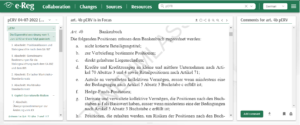
pOFR_German

The window on the right of the screen shows the comments already created on this item 4b “Portefeuille de la banque”. At the bottom of the same window, employees who have access to e-Reg can click on “add a comment” to take part in their bank’s internal consultation.

b – Monitoring comments generated by e-Reg as part of this consultation process

Each user then has access to a dashboard for an overall view of actions and comments. By typing “pCAO” again in the search bar on this page, e-Reg displays all the comments created. All these comments can be exported to Excel (see 3.3. below).

3 – Managing the impact analysis of a new financial regulation with e-Reg

Our RegTech tool makes it possible, in the same way as for a consultation, to record employees’ analyses and opinions on a regulatory change when it is implemented.

3.1 – Gathering comments from within the banking institution

The aim of the study is to estimate the impact of changes to the regulatory framework on a bank’s internal operations. This collaborative function facilitates consultation and the sharing of information and analyses. Our system concentrates all the information in a single, collaborative dematerialised space.

The tool allows users to be mentioned in order to gather their input on a particular point.

3.2 – Example of a comment added to our RegTech tool

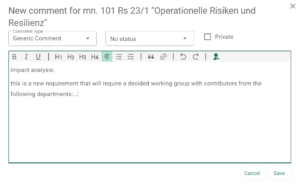
During the implementation of the new FINMA circular 23/01 on operational risks and resilience, here is a comment added to the platform for marginal number 101 :

Add_new comment_EN

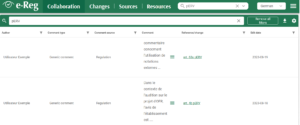
As with a consultation, the responsible of the impact study can lists all the comments and analyses made by contributors on his dashboard:

List all comments in English

Each e-Reg user can export all their comments to Excel (see below).

3.3 – Additional e-Reg functionality: exporting comments

The person responsible for the regulatory consultation project or impact assessment can easily export all comments to Excel. This is useful for reworking them. It’s also handy for preparing reports, particularly if several departments are involved.

Excel export comments FINMA 23 01

e-Reg’s collaborative features are ideal for gathering opinions and comments. Whether it’s a question of consulting the authorities or analysing the consequences of a new regulation, adopting RegTech simplifies the process. To get a better idea of how our e-Reg solution makes your regulatory work easier, why not arrange a personalised demonstration of the tool?