


Switzerland’s financial services industry is looking for new tools and technologies to help them manage regulatory and compliance issues. This is what RegTechs are all about. We designed e-Reg with this in mind. In this article, we invite you to discover the RegTech functionalities of our solution, divided into two categories: regulatory knowledge management and collaborative project mode.
1 – RegTechs: objectives, technologies and functionalities
Over the years and after financial crisis, reforms have piled up, making regulation more complex for the financial services sector. Swiss banks and the firms that advise them have everything to gain from adopting these new technologies for their compliance missions.
1.1 – What do RegTechs do and why?
What is RegTech ? Regulatory technology is the term used to describe the set of companies that use technology to offer services to banks and their environment, in order to comply with regulations. In other words, these companies help banks to remain compliant with regulations, or to bring themselves in line with them.
RegTechs operate in a wide range of fields. The services offered can be divided into 4 categories:
- real-time monitoring of financial transactions for fraud detection and anti-money laundering purposes;
- improving customer knowledge, for example through KYC (Know Your Customer) around the topics of identifying and analyzing customer habits;
- regulatory management, such as identifying texts or standards to be implemented in the financial institution;
- collection, analysis and forecasting of large volumes of data.
1.2 – What technologies do Regtechs use?
To offer functionalities that address these diverse issues, this tech sector relies on innovative technologies:
- artificial intelligence (AI) and machine learning to analyze data (transactions, texts, images);
- big data for processing large volumes of data ;
- automation of workflows and procedures.
1.3 – easyReg, a Swiss RegTech to simplify financial regulation
Recognizing the need for regulatory simplification, we have developed a tool called e-Reg. Available in SaaS mode to all financial services specialists, our application features many practical RegTech functions.
In the rest of this article, we’ll take a closer look at these features, classifying them into two major categories, information management and collaborative management. All these functionalities contribute to :
- improve compliance with regulations and reduce the risk of non-compliance with its induced financial cost ;
- increase and share employee knowledge;
- reduce the time spent on regulations ;
- facilitate collaborative working and change management in project mode.
2 – e-Reg’s RegTech features for regulatory knowledge
e-Reg’s technology focuses first and foremost on the regulatory material itself, the sources of information. Whether legislative texts, ordinances, regulations, explanatory reports from the Federal Department of Finance (FDF) or FINMA, draft acts, etc., the management of financial regulations comprises thousands of pages.
2.1 – Search in the Swiss financial regulations
This functionality is the first perceived use by e-Reg customers. With our application, they can access all regulatory information in a completely digitized way. For the regulatory search, they can choose between entering an expression or a specific text (e.g. FINMA Circular number).
2.2 – Understanding and knowing the regulatory context
Not only does e-Reg respond to a search in financial regulation, it goes further. This RegTech tool completes the online information by providing a global context. At the bottom of the screen, it displays other elements that include a reference to the subject of the search. All information includes clickable links. This makes it easy to navigate from one regulatory reference to another. Our customers can also choose to open new windows when clicking on these links.
2.3 – Managing knowledge within a team or consulting firm
This regulatory management tool also makes it possible to manage knowledge both within banks and among the consulting firms that support them in regulatory matters. All have a single point of access for consulting, analyzing and commenting financial regulatory texts applicable in Switzerland.
Therefore they keep track of their work. They can document any special processes they need to carry out, thanks to RegTech. This e-Reg feature facilitates the transfer of knowledge between teams, particularly during periods of absence or leave. It’s a way of reducing regulatory risks.
2.4 – Regulatory libraries
This RegTech functionality provides a paperless way of storing all compliance-related regulations in Swiss banks and financial institutions. This technological process provides access to information in several languages. It enhances the user experience. These libraries are linked to the knowledge management and team collaboration system.
2.5 – Complement regulations by including internal policies and procedures in the RegTech tool
Here’s another regulatory knowledge management feature. E-reg proposes an optional module for including in the tool the directives and other internal documents essential for implementing regulations. This process takes place in a private, segregated environment. The bank can group together in one place the texts in force in Switzerland, as well as its own procedures or policies.
This enriches the results of a search in the tool. Users have all the information in one place. For example, it’s an interesting RegTech feature to directly consult all the texts (internal and external) applicable to a particular issue. For instance, you can quickly identify relevant internal directives for new employees.
3 – e-Reg features: collaborative mode and project management
Managers and employees in the financial services sector are sometimes looking for solutions to manage their cross-functional projects. How do you get several people working together in the same department or law firm on regulatory tasks? e-Reg also meets these needs, helping to simplify regulations.
3.1 – E-reg: features that encourage collaboration
This is the second focus of our RegTech solution. All online processes are designed to facilitate knowledge exchange, as well as the planning and monitoring of regulatory projects.
a – e-Reg’s comment function
Having up-to-date, centralized regulatory information is great. It’s even better to be able to analyze and comment on it directly in the RegTech tool. This feature allows our customers to insert a comment when reading the regulations.
Click on “Add a comment”.

The following window appears, allowing you to select a comment type and status:
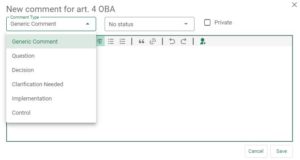
All comments entered in e-Reg can be exported to Excel.
b – Informing colleagues in financial services
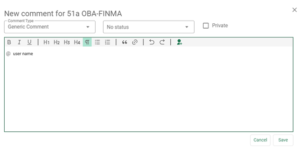
Collaborative functionality means that the e-Reg user can inform other people in a department, firm or who are working on a regulatory project of the existence of the comment. When adding a comment, you can notify a person. By typing @, you can access the list of e-Reg users in the company:
3.2 – Managing change in banking establishments
The collaborative mode also means that e-Reg is the ideal tool for bringing projects to fruition. With its task tracking and scheduling functions, our application facilitates the management of files such as regulatory changes.
Our RegTech solution allows you to :
- view the status of changes in progress at all times;
- view essential information in the dashboard ;
- create reminders for actions to be carried out on the project ;
- document regulatory changes on an ongoing basis;
- export the dashboard to an Excel file at any time, e.g. for internal reporting purposes.
3.3 – Managing a consultation with authorities or carrying out an impact assessment
e-Reg makes it easy to manage a regulatory consultation. In particular, the application helps to collect comments from employees before drafting a response. This is also the case for a financial institution’s internal analysis of new regulations. This collaborative mode of the tool facilitates the formalization of the impact analysis by the various departments concerned. All these comments can also be exported to Excel.
With all these features, e-Reg is a practical and operational RegTech solution for Swiss banks and the financial services sector in general. The tool is quick to implement. We provide a customized support to all our clients. To improve your perception of the tool and complete your thinking, don’t hesitate to schedule a demonstration with Enrico Giacoletto.
👉 Sign up for our Newsletter to keep up to date with the latest regulatory news and follow any announcements of new rules or major changes.